


Introduction
In today’s phenomenon, staying clean and social distancing plays a big role when it comes to minimizing this disease that has been spread around the whole world. Having technology that can differentiate an object that is clean or dirty just from a scan can help save many lives. Knowing if some object is dirty, can help minimize many people from getting sick by touching things they do not know if it is clean or dirty. Our product, RiskWatch can help you identify those objects. Creating RiskWatch, we thought that having a watch is like having a smartphone, it has the features to do the identifying. As well as a small camera to detect an area.
Ideation
Coming up with the idea:
Thinking of an idea was the first process, each group member took about 20 minutes to jot down their knowledge and create a list of UbiComp technology.
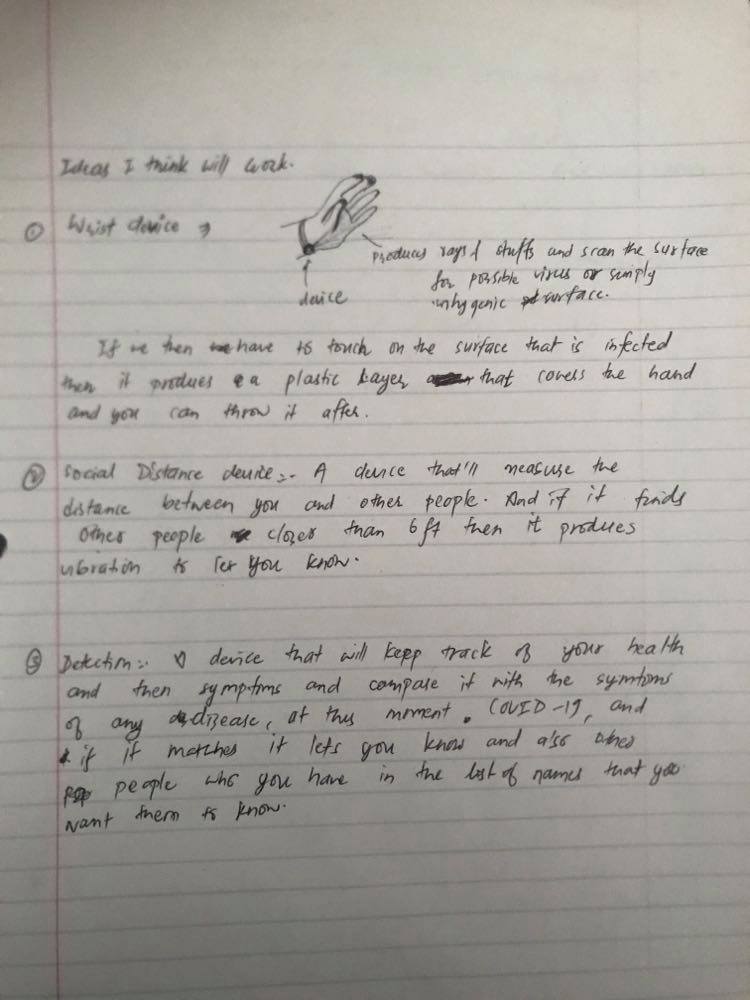

Final Idea:
After collaborating and sharing our ideas, we agreed upon the idea with the most potential. Then we started to discuss the final idea more and created different features we can include to our UbiComp device.
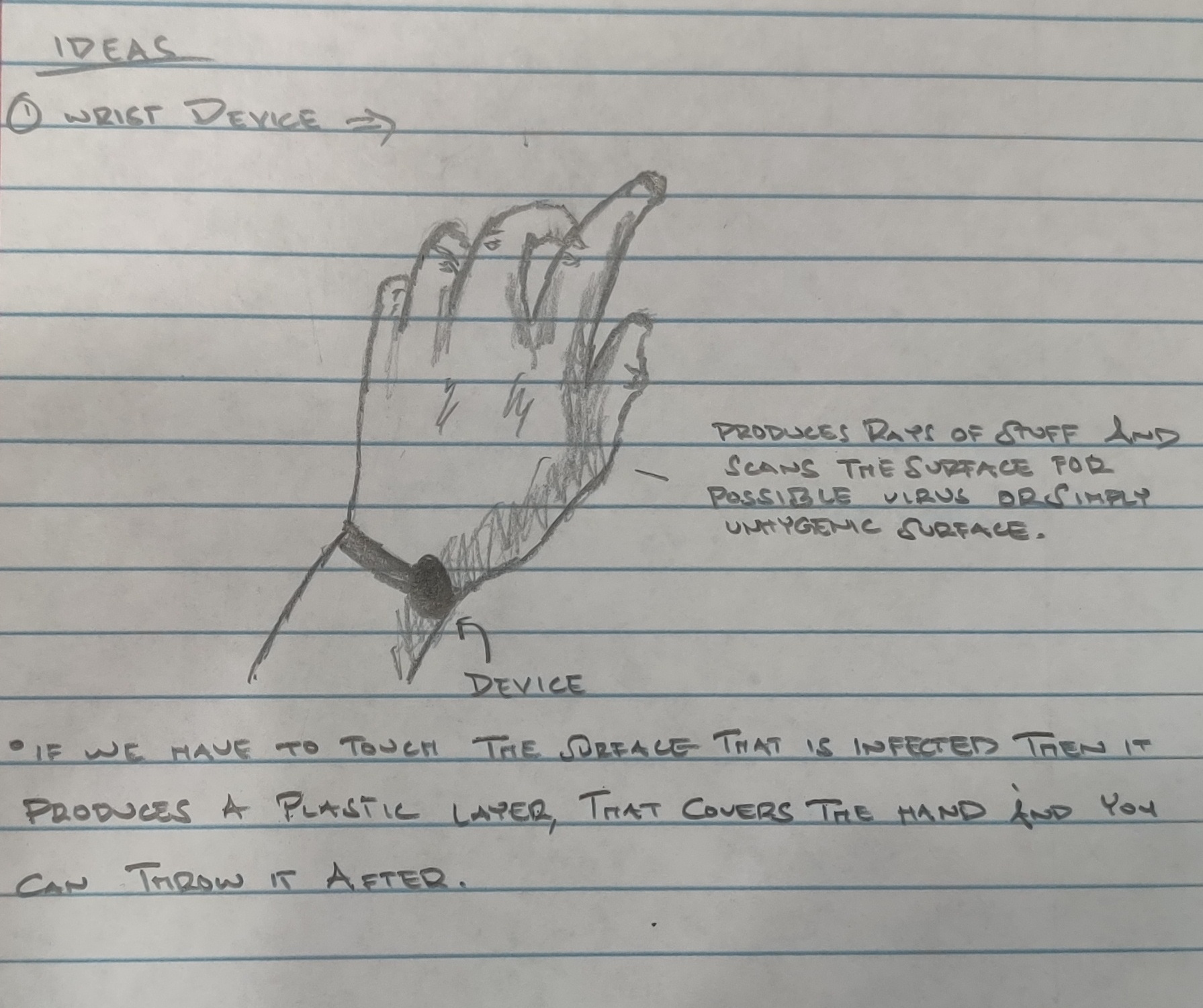
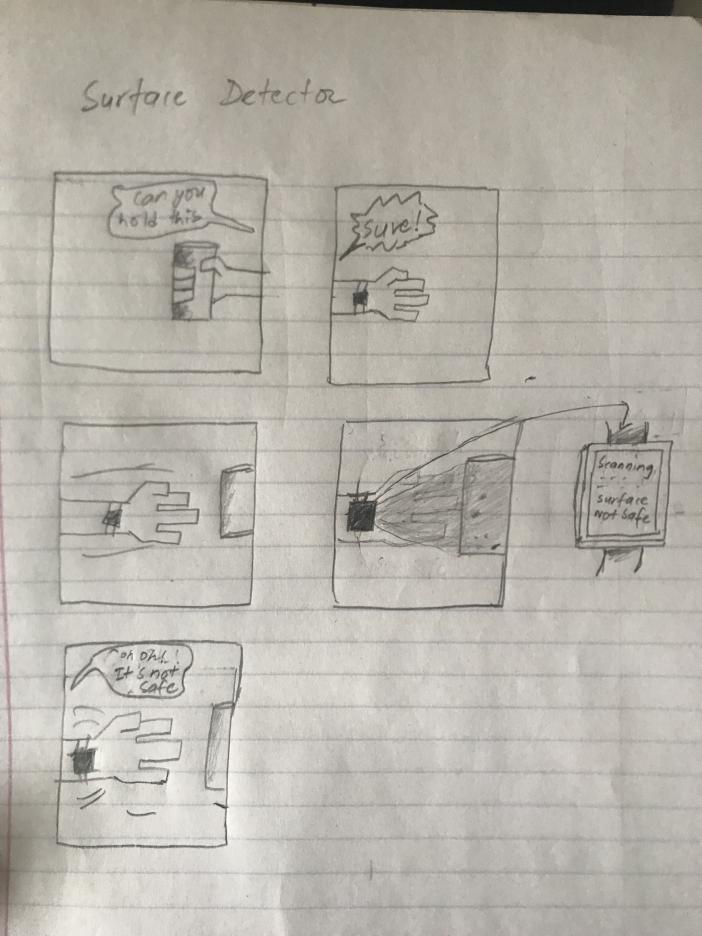
The images above shows our idea process after agreeing to RiskWatch as our final idea of the device
Designing RiskWatch
For our groups device design, we thought of creating a device that would help throughout this pandemic. The idea of our device is to help people stay safe by making sure they avoid unsafe surfaces. At first we had another idea, to create a social distance device. That device will measure the distance between you and other people. If it detects someone who is closer than 6 feet from you, it produces a vibration to warn you. But this design did not last long for us, we thought it was to practical. Instead, we came up with RiskWatch. Our thoughts on this app was to save the people’s life. At first when the idea first came up in our mind, we thought it would be a great way for people to avoid touching unsafe surfaces. You might not know it, but many bacteria from the virus stays on the surface for more than a couple hours or even a day. Our thought was to minimize people touching unsafe surfaces. Some people would touch the unsafe surface than touch their face, causing them to get sick afterwards.


The idea of RiskWatch is to let people know what they are touching and if it is safe to touch. With the whole pandemic, many people are getting sick from not washing their hands after touching something. We designed RiskWatch to prevent people from getting sick after touching a not clean area. After thinking about people not washing their hands after touching an area, we created another idea of the device producing a plastic to wrap around your hand to touch something if it unsafe to touch. After doing so, you can throw away the plastic and put replace it with a new plastic. Another feature that we came up with was a heat detector feature. This would mainly be useful for people who are disabled. With the heat detector it would detect if a surface is too hot to touch. If the surface is then too hot, then it produces a notification to user. In designing this device, we hope that RiskWatch can fulfill your expectations and help save lives.
Storyboard
(click on image to view original size)


The storyboard is our roadmap in creating the video prototype. It demonstrates the basic usage of our device and helps our consumer understand what our product is. Understanding different ways to storyboard, we will be able to set a plan to create our video design. Regardless of your budget or design experience, you’ll be able to create a clear map that seamlessly guides you through production.
Video Prototype
Evaluation
Survey: https://sonoma.az1.qualtrics.com/jfe/form/SV_5A6HW420dg0k1lH
Our initial idea of the survey was to get our consumers input on how often they wear watches, what they are looking for in a smartwatch that can detect viruses, what can be improved after watching our video prototype, and their own thoughts about our device helping disabled people. By answering the different types of questions, we know how we can improve the device to satisfy our consumers experiences.


After getting feedback for our survey, we realized that our consumers wanted for us to ask them how to improve our product. This was a way for us to take back their feedback on the device and make it fit their expectations. One of the feedback to our survey was our heat feature. We wanted to implement a heat feature on the device to help people with disabilities. This would detect if a surface is hot, then notify the user that they should not touch that area. The idea of the heat feature was our main positive feedback in the survey. Other than that, the feedback to the survey were all positive. Many enjoyed how fast and easy the questions were, but yet difficult enough for them to think and answer. The survey aimed to get information about how often people use wearable technology as well as the functions and usability. After getting our consumers input, we will then understand more about their expectations and how we can improve RiskWatch in the future.
Strengths and Weaknesses of Final Prototype
After we received feedback from our survey applicants, as a group we felt satisfied with the feedback. Many respondents gave us positive feedback about our product.
However, we did notice some weaknesses regarding our device because of the prototype. Some of our respondents gave negative feature, because they viewed our device as a magical COVID-19 detector. Although that was not our intention to create a COVID-19 detector, our idea of including COVID-19 was an example of a disease or a virus that it could detect.
Worked?
- All agreed to the topic
- Successfully thought out our device functionality
- Created features that would help during this pandemic
- Easy and user friendly device
- Our device helps people who are disabled
Didn’t Work?
- First video prototype
- Questions in our survey were confusing
Implication For Design
After completing the design for this Ubicomp maker process, the thoughts of improving this prototype has came cross our minds. Some factors that can be improved in our device would be making the scanner more reliable or known to all types of viruses and diseases. By doing this, we would have to download it into the software of this device. As of now, we designed this device to detect and scan basic viruses. Also, another factor that we can improve on was the example of virus we used in the video prototype. It seemed like it caused a huge confusion to what we wanted our device to demonstrate. Our device can detect a virus by scanning the area and the object. By doing this you can see if an area is clean to touch, so you do not get sick from touching unsanitary things.
Social Distancing
As the spread of COVID-19 continues, many communities are being asked to reduce close contact between people. In doing so, we are practicing social distancing. This is an effective way to help slow down the spread of the virus. Social distancing means staying at home as much as possible and avoiding crowded, public places where close contact with others is very highly. Now everywhere, there is an order to stay at home in many cities. An outcome of that would be cancelling events and gatherings of more than 10 people, closing shops, restaurants and bars, movies, etc. Only essentials are open, like grocery stores and food places that only do takeout.
With everything closed and social distancing, that does not mean you have to isolate yourself from friends and family. Staying connected with each other is more important than ever. Similarly, staying connected to our social groups provides familiarity, solidarity, and most important is comfort. There are many ways to stay connected with others, think of creative ways to stay in touch with your friends and families. This includes social media, Facetime, Skype, Zoom calls, etc.
Be Ready For The Next Pandemic
We do not know what virus will cause the next pandemic, and there is no way to develop and deploy an effective vaccine against the virus. The step we can do is to be prepared for it and monitor updates and news about the pandemic. A way to be prepared for the pandemic that we saw going on during this pandemic would be stockpiling. Other than that, we learned a new strategy to prevent or decrease the likelihood of getting the virus by maintaining personal spacing and decrease contact between individuals, practicing good hygienes, using masks for going out, and intervening by closing big gathering locations.
Concluding Summary
When designing wearable technology, as designers we need to focus on how the user can best achieve their experiences with our product. Also, we need to develop a journey for the user by crating mental models and evaluating how to best align the users intuitive perception of the product. While creating this device, we thought about this process of keeping the user satisfy with our product. So we decided to create RiskWatch to satisfy the needs of many people during this pandemic. Many people are in fear and taking caution about the objects and surfaces they touch. While creating this device, we had some ups and downs on some ideas on how we can keep our consumers satisfy with the device. Some of our highlights in designing this product are the heat feature and that this product can help save lives by detecting a surface that is unhygienic.
Other than the features of RiskWatch, we expect this device to be useful during this COVID-19 situation. During this pandemic, we have to practice social distancing and being prepared for the next pandemic. For social distancing, that does not mean you have to isolate yourself. There are many creative ways to stay in touch with friends and family. After this situation dies down, we hope that idea of staying clean and having good hygienes still takes an active role in our lives.










 Human computer interaction portfolio